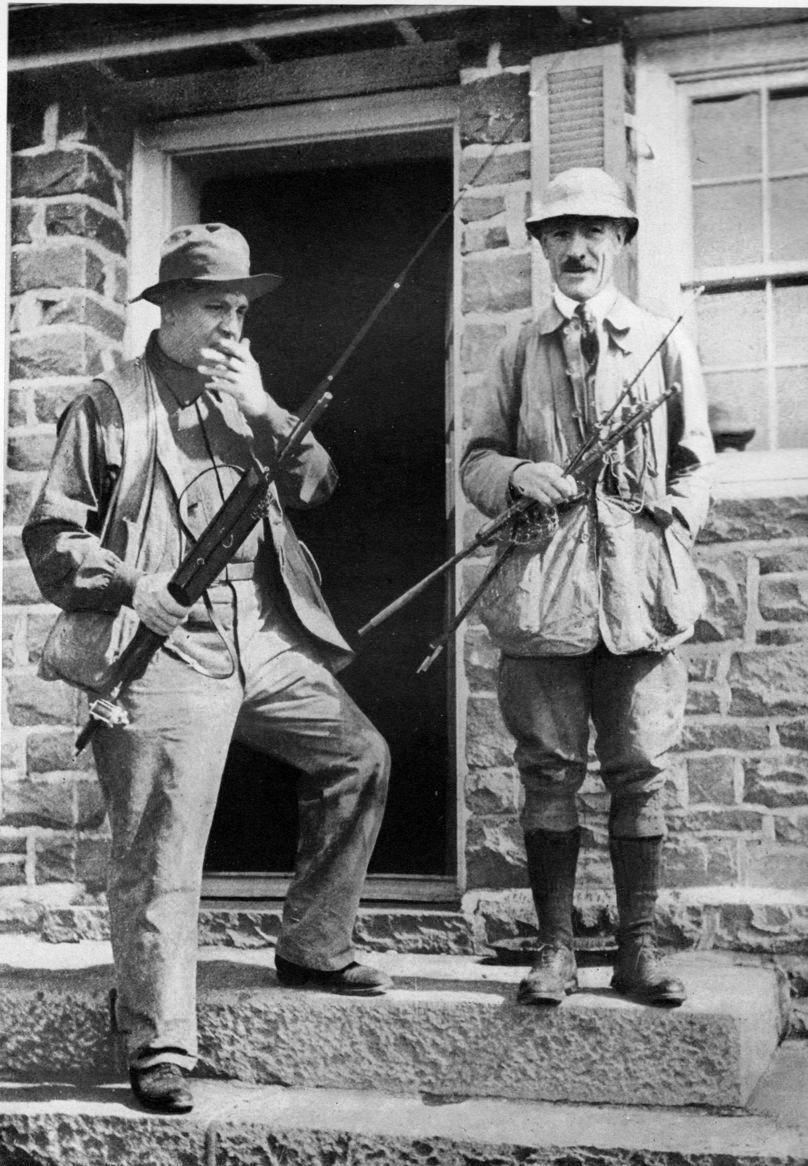
What We Learned from Ken Milton in the 1980s

A great knot for shooting lines
The Old Fisherman's Knot A Better Loop Knot for Shooting Lines
Strong. Slim. Perfectly centred.
We reposted this blog post from 2020 to bring it in line with the other loop blogs in the series. As part of the update, we also created a new set of illustrations to make the instructions clearer and easier to follow.
For more than 25 years, this simple French knot has been my preferred way of creating loops on shooting lines.
It is strong, remarkably streamlined and easy to tie. More importantly, it creates a loop that remains naturally centred on the shooting line – a feature that sets it apart from many common loop knots.
After thousands of hours fishing salmon and sea trout with shooting head systems, it remains one of the most elegant and practical loop connections I know.
“The best knots are often the simplest ones.”
The Story Behind The Knot
Around the year 2000, my good friend and topwater specialist Eric le Guyader showed me a knot that he had used successfully for years.
He referred to it as:
Le Noeud du Vieux Pêcheur
(The Old Fisherman’s Knot)
At the time I was constantly experimenting with shooting head systems, searching for cleaner, stronger and more efficient connections.
The knot immediately stood out.
It was compact, elegant and practical.
Most importantly, it worked exceptionally well on the monofilament shooting lines that were becoming increasingly popular among salmon anglers.
More than two decades later, it remains one of the knots I trust the most.
Why I Still Use It Today
Many loop knots will get the job done.
The Old Fisherman’s Knot offers several advantages that have kept it in my system for more than twenty-five years.
✓ Extremely slim profile
✓ Passes smoothly through rod guides
✓ Strong and reliable
✓ Easy to tie even with cold fingers
✓ Creates a perfectly centred loop
✓ Excellent balance when used with shooting heads
✓ Ideal for monofilament shooting lines
“Strong enough to trust. Simple enough to remember.”
A Uniform And Balanced Connection
Many loop knots look like a knot attached to a line.
The Old Fisherman’s Knot looks like a continuation of the line itself.
The knot, loop and shooting line form a compact and highly uniform structure without large protrusions or unnecessary bulk.
This uniformity improves guide passage, reduces visual clutter and creates a cleaner overall system.
For anglers who appreciate efficient and elegant tackle design, that uniformity is one of the knot’s greatest strengths.
“Uniform. Balanced. Proven.”
Why A Centred Loop Matters
One of the most overlooked characteristics of a loop knot is its geometry.
Viewed from above, many traditional loop knots create an offset loop. The centre of the loop sits to one side of the line’s centre axis rather than directly in line with it.
The result is a connection that is inherently asymmetrical.
While the effect may be subtle, every offset introduces a small degree of imbalance into the system. Energy is no longer transferred perfectly through the centreline of the shooting line and loop connection.
The Old Fisherman’s Knot behaves differently.
Its structure naturally positions the loop on the centre axis of the shooting line.
The connection remains symmetrical, balanced and uniform from end to end.
This creates cleaner energy transfer, a more refined casting feel and a connection that behaves like a natural continuation of the line itself.
“One of the few loop knots that truly stays centred.”
“Not just strong. Geometrically correct.”
Smooth Through The Guides
A smooth connection is a faster connection.
One of the reasons I originally adopted this knot was its ability to pass cleanly through rod guides.
The slim and uniform profile creates very little resistance compared to bulkier loop connections.
Whether stripping line aggressively, changing direction during a cast or landing a fish close to the rod tip, the knot passes through the guides with remarkable ease.
Small details often create the biggest improvements.
This is one of them.
“A smooth connection is a faster connection.”
Where This Knot Excels
I primarily use this knot on:
- Rio SlickShooter
- Ken Sawada Flat Beam
- Other monofilament shooting lines
- Salmon shooting head systems
- Sea trout shooting head systems
Although it can be used on many different materials, it was originally adopted as a solution for thin, hard shooting lines where a slim and durable loop connection is particularly important.
Important Note About The Illustrations
The illustrations below have been created using a considerably thicker fly line than the materials I would normally recommend for this knot.
This was done deliberately to make the individual steps easier to see and understand.
In practical fishing situations, I primarily use this knot on monofilament shooting lines such as Rio SlickShooter, Ken Sawada Flat Beam and similar materials.
The thicker line shown in the illustrations is simply a visual aid designed to make the knot structure more obvious and easier to follow.
The tying method remains exactly the same.
How To Tie The Old Fisherman’s Knot
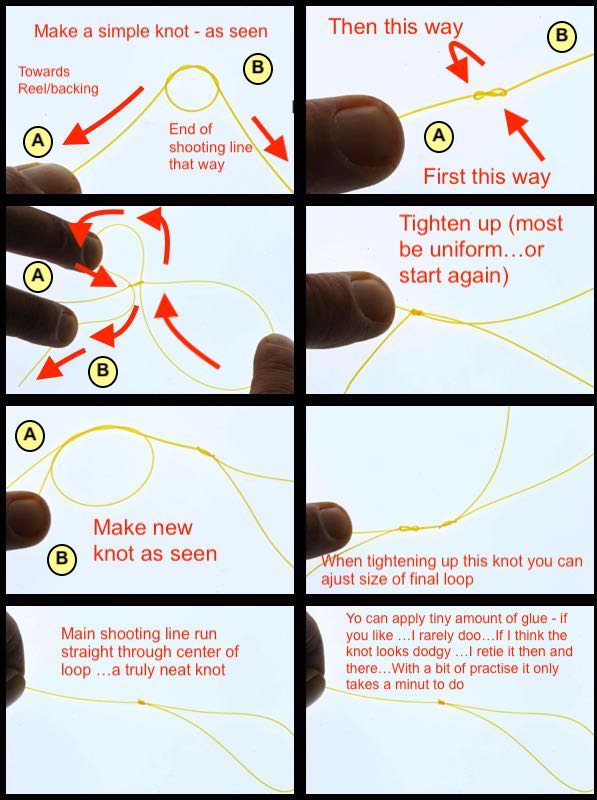
The knot consists of two simple granny knots tied around a loop.
The first knot creates the foundation and centres the loop on the shooting line.
The second knot locks the structure and creates a remarkably strong and streamlined connection.
Follow the illustrations below and tighten each step gradually rather than pulling everything tight at once.
Consistency is more important than force.
A correctly tied knot should look neat, symmetrical and compact.
A Small Detail That Makes A Big Difference
Fly fishing has taught me that small details often create the biggest improvements.
A loop connection may seem insignificant compared to rods, reels or fly lines, but it is one of the few components that affects every single cast.
The Old Fisherman’s Knot is exactly that kind of detail.
It takes less than a minute to tie, yet it creates a cleaner, smoother and more balanced connection than many common alternatives.
After thousands of hours fishing shooting heads for salmon and sea trout, it remains one of the simplest upgrades I can recommend.
About Eric le Guyader
Much of what I know about surface techniques, skating flies and topwater salmon fishing has been influenced by conversations and time spent with talented anglers over the years.
Eric le Guyader was one of those people.
This knot is one of several valuable lessons that stayed with me long after our fishing trips.
The best fishing ideas are often the simplest ones.
This knot is a perfect example.
Eric Le Guyader, one of France’s true topwater pioneers, with a beautiful sea bass from the powerful and treacherous waters of Raz du Sein.
Questions?
If you have questions about shooting heads, shooting lines, salmon fishing or sea trout systems, feel free to get in touch.
Jesper Fohrmann


Comments (0)